

White paper
How Readable Is the Business Web to AI?
The SeraVerra AI-Readiness Study: 11,320 business websites, October 2026
Abstract
AI assistants increasingly stand between a business and its next customer: discovery more and more often starts with a question put to an assistant, and the assistant answers from what it can read. We scanned business websites to measure how completely an automated reader can read them.
We attempted 13,342 sites in October 2026. After excluding sites that were dead or never answered, the study set is 11,320 sites, of which 10,369 produced a score. Across the scored sites the average AI-readiness score was 67.1 out of 100 and the median was 68. Only 332 sites reached the Ready band (90–100): 3.2% of scored sites, 2.9% of the study set. A further 752 sites, 6.6% of the study set, refused automated reading outright.
The pattern underneath is consistent. Most sites that let a reader in load fast and admit crawlers, then lose their facts in structure, metadata, and missing question-and-answer content. This paper sets out the method, the results and what they mean, including what a readiness score does not measure.
1. Why this study
When a customer asks an assistant to recommend a business, the assistant can only work from what it can read: the pages it can fetch, the facts it can extract, the structure it can follow. A business whose site resists that reading is not judged and rejected. It is simply absent from the material the answer is built from.
That makes readability to AI systems a measurable business property, like load speed or mobile layout. This study measures it on a population large enough for the patterns to matter: the gaps are not random, they cluster in the same few checks, and they are fixable with ordinary web work.
One limit, stated at the start rather than the end: a readiness score measures how completely an automated reader can read a site. It does not measure, and cannot guarantee, whether an assistant will cite or recommend the business. A high score means the door is open. It is not a promise that anyone walks through it.
2. Method
2.1 Population
We attempted 13,342 business websites in October 2026. Every attempted site is accounted for below.
| Group | Sites | Treatment |
|---|---|---|
| Attempted | 13,342 | |
| Dead (no site at the address) | 1,037 | Excluded: nothing to evaluate |
| Never answered | 985 | Excluded: nothing to evaluate |
| Study set | 11,320 | All results below describe this set |
| Refused: 403 Forbidden | 449 | Kept as a result (§5), no score |
| Refused: 401 login required | 303 | Kept as a result (§5), no score |
| Not scored, no outcome recorded | 199 | In the study set; no score |
| Scored | 10,369 | Scores and category averages are computed over these sites |
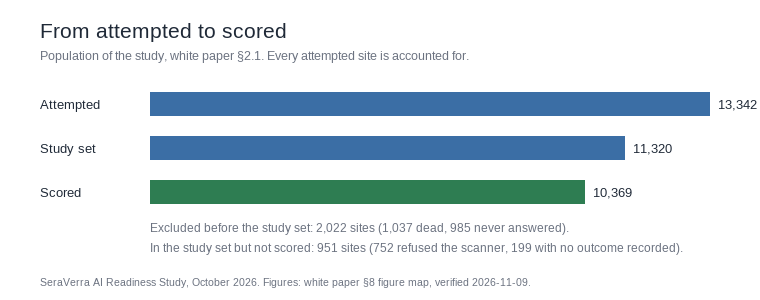
Refusals stay in the study set because a refusal is a result, not a missing value. No scored site in this study has a score of zero: every site in the scored set produced a score above zero, and every site that produced no score is accounted for in the table above — the refusals (§5) and the 199 sites with no outcome recorded.
2.2 The scan
Each site is fetched the plain way: the raw page, not the JavaScript-rendered version, because that is the fetch a reading system gets first. The test is the same as a person using "view source": if the facts are not in what the fetch returns, they are not reliably available to be read.
2.3 The score
Every scored site receives a score from 0 to 100, built from five weighted checks and one adjustment.
| Check | Points | What it reads |
|---|---|---|
| Crawler access | 20 | Whether AI crawlers may fetch the site: robots.txt rules for the eight named AI crawlers the scanner checks (GPTBot, ChatGPT-User, CCBot, ClaudeBot, PerplexityBot, Google-Extended, Applebot-Extended, cohere-ai) and the server's responses |
| Structure | 25 | Headings, page labels and the document outline a reader follows |
| Metadata | 25 | Titles, descriptions, and the structured data that states the business's facts |
| Content | 15 | Whether the page carries enough readable text to answer from |
| Performance | 5 | Whether the page loads fast enough to be fetched in full |
| FAQ signals | ±10 | Question-and-answer content, as an adjustment (below) |
Each check is scored 0–100 and contributes its share of the points; the five checks together give a base of up to 90. The FAQ adjustment then adds or subtracts a flat 10: an FAQ score above 70 adds 10 points, and a score of 40 or below subtracts 10 points; between those bounds it changes nothing. Final scores are held within 0–100. A site that scores zero on crawler access is capped at 40 overall: a site that cannot be entered cannot be read, whatever else is true of it.
Scores fall in three bands: Ready (90–100), Workable (70–89) and Needs Work (0–69).
3. Headline results
Across the 10,369 scored sites:
- Average score: 67.1 out of 100.
- Median score: 68, so half of scored sites sit inside the Needs Work band, one band below Workable.
- Ready: 332 sites scored 90 or above: 3.2% of scored sites, or 2.9% of the whole study set.
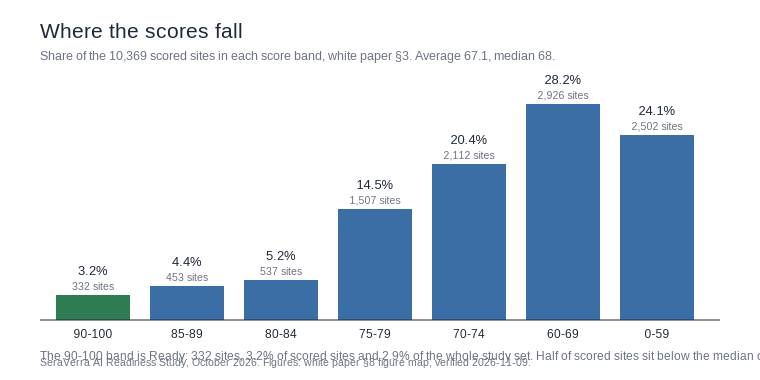
The centre of the distribution is the finding. A median of 68 is not a story about a long tail of broken sites dragging an average down. It is the typical business website, loading normally and looking fine to its owner, sitting one band below Workable because of how it reads to a machine.
4. Category results
The six category averages across the 10,369 scored sites, strongest to weakest:
| Category | Average |
|---|---|
| Performance | 99.0 |
| Crawler access | 98.1 |
| Content | 84.2 |
| Metadata | 80.8 |
| Structure | 70.5 |
| FAQ signals | 43.9 |
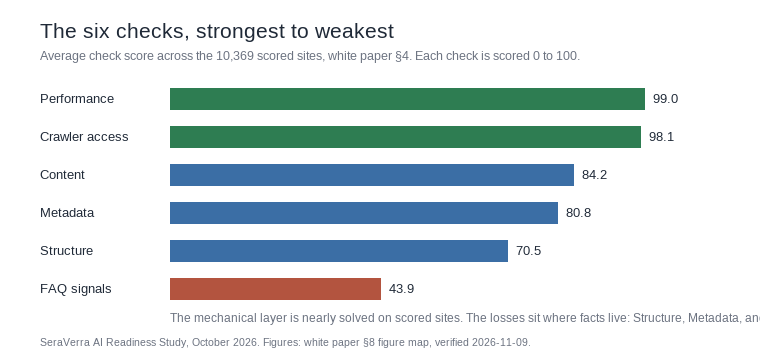
Two things stand out. First, among sites that let the scanner in, the mechanical layer is nearly solved: almost every scored site loads in full and admits crawlers. That statement covers scored sites only; the 752 sites that refused automated reading entirely are the subject of §5.
Second, the losses concentrate where facts live. Structure and metadata decide whether a business's name, services, address and hours survive extraction, and FAQ signals, the question-and-answer content assistants quote most directly, is the weakest check by a wide margin.
Weighted by their points, the five check averages give an average base of about 75 of the 90 base points. The FAQ adjustment and the crawler-access cap together take the overall average down by about eight points, to 67.1.
The weights follow the same evidence: structure and metadata carry 25 points each because that is where facts get lost, and performance carries 5 because it rarely separates one site from another.
5. Refusals
752 sites, 6.6% of the study set, refused the scanner outright: 449 returned 403 (Forbidden) and 303 returned 401 (login required). These sites have no score and no check results, so they are not in the averages in §3 and §4. They are reported here as their own finding, and arguably the most absolute one: a site that turns automated visitors away cannot be read by them at all.
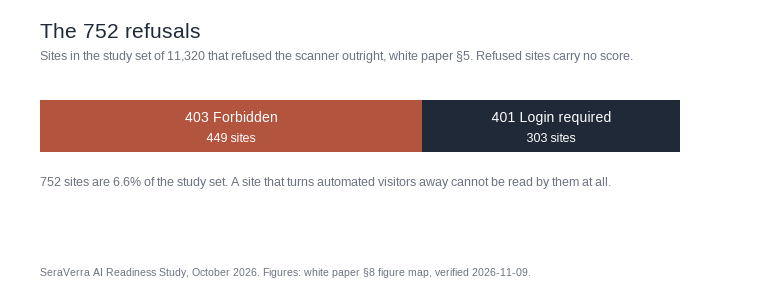
The refusal is also invisible from the front of the site. The same address loads normally for its owner, who is logged in or on an allowed network.
A refusal to our scanner is a signal about AI crawlers in general, not proof of how each named crawler is treated: firewalls distinguish between automated visitors, and some verify them individually. What a 403, or a site-wide 401, establishes is that the site's defences refuse automated reading in general. That is the first thing to check, because every other fix assumes a crawler can get in.
6. What this means for companies
For companies, the study's value is that its findings are client-presentable:
- The gaps are concrete: a heading outline that loses the services, a missing FAQ page, a firewall rule nobody knew was there.
- The fixes are ordinary web work: headings, structured data, an FAQ section, a robots.txt or firewall change.
- The score gives a before-and-after number that doesn't depend on anyone's opinion, and the client can check it by reading the same report.
The readiness conversation is also an honest one to have. The claim is never "this will get you recommended." It is "this is what an assistant can and cannot read on your site today, and here is the ranked list of what to fix."
7. Limitations
- One fetch method. Scores reflect the plain fetch. A site that shows essential facts only through JavaScript is scored on what the first fetch returns. That is the method's deliberate choice, and also its boundary.
- One window. All scans ran in October 2026. Sites change; a score is a measurement on a date, not a permanent property.
- One sample. Results describe the 11,320 sites in the study set as defined in §2.1. They generalize to business websites at large only as far as that sample represents them.
- Two denominators. Scores, medians and category averages describe the 10,369 scored sites; refusals (§5) are reported against the full study set. Each figure in this paper names its base.
- What the score is not. As stated in §1, the score measures readability. It does not measure, predict or guarantee citation or recommendation by any assistant.
8. Data availability
The study's underlying dataset is published as the companion download to this paper: one row per attempted site, with its group (§2.1), score and check results, so that any figure here can be re-derived from the data it came from. The paper names no sites in its text; the dataset download link stands with the paper.
Download the dataset behind this paper (Excel, one row per attempted site):
Every figure in this paper, and where it comes from:
| Figure as used | Source |
|---|---|
| 13,342 attempted | Study record (verified) |
| 2,022 excluded from the study set (1,037 dead + 985 never-answered) | Reader-set classification (verified) |
| 11,320 in the study set | Verified reader set |
| 10,369 scored | Verified reader set |
| Average 67.1 · median 68 (over the scored set) | Verified reader set |
| Ready 332 = 2.9% of the study set (3.2% of scored sites) | Verified reader set |
| Category averages 99.0 / 98.1 / 84.2 / 80.8 / 70.5 / 43.9 | Study record (verified) |
| Refused 752 = 449 (403) + 303 (401) | Study record (verified) |
| Formula, weights, bands, cap | Methodology record (verified) |
| Honest limit | Methodology record (verified) |
Appendix — Definitions
- Attempted: a site our scanner tried to scan in October 2026 (13,342).
- Study set: attempted sites minus the dead (1,037) and the never-answered (985): 11,320.
- Scored: a study-set site that produced a score above zero (10,369).
- Refused: a study-set site that turned the scanner away — 403 Forbidden (449) or 401 login required (303): 752. Refusals are results within the study set and carry no score.
- Not scored, no outcome recorded: 199 study-set sites whose scans returned no outcome.
- Ready / Workable / Needs Work: score bands 90–100 / 70–89 / 0–69.