

Blog · Nov 14, 2026 · SeraVerra Research · 3 min read
Custom-built should win. The platforms finish ahead of it.
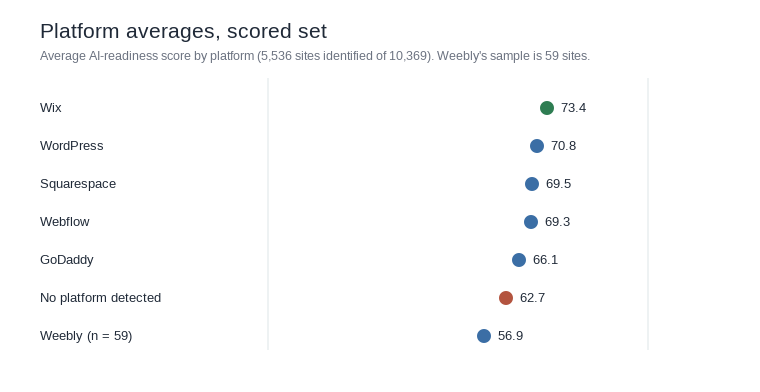
Sites with no detected platform average 62.7 — below Wix, WordPress, Squarespace, Webflow and GoDaddy. The template's floor is the reason.
Key takeaways
- A platform could be identified for 5,536 of 10,369 scored sites: Wix 73.4, WordPress 70.8, Squarespace 69.5, Webflow 69.3, GoDaddy 66.1.
- The other 4,833 sites (47%) carried no platform we could identify, and averaged 62.7 — below every one of those platforms.
- Weebly sits lower still at 56.9, on just 59 sites — a small sample, and the reason the claim is scoped to substantial platforms.
Every custom shop believes its builds are better than a template. On craft, they often are. On AI readiness — whether the finished site can be read, understood, and cited by the assistants customers now ask — the data says the custom class finishes behind every substantial platform it was measured against.
In our scored set of 10,369 sites, a platform could be identified for 5,536. The averages: Wix 73.4, WordPress 70.8, Squarespace 69.5, Webflow 69.3, GoDaddy 66.1. The other 4,833 sites — 47% — carried no platform we could identify, and they averaged 62.7, below every one of those platforms, about 11 points behind Wix. One platform class sits lower still: Weebly, at 56.9 — on just 59 sites, a small sample the data itself flags, and the exception that keeps this honest: the claim is not that custom finishes last of everything, but that it trails every platform with a substantial presence in the set.
One honesty note before the argument: "no platform detected" is a mixed class. It holds true custom builds, less common systems, and sites where our detector found no clue. It is not a pure census of custom work. But it is the class custom work lives in — and two more differences in the data describe that class precisely.
Its crawler access fails far more often. 3.41% of no-platform sites scored 40 or below on crawler access, against 1.32% on WordPress and 0.09% on Wix. And its content hides behind scripts: 7.3% of no-platform sites showed at least 30% more words after JavaScript ran than in the raw page — against 3.6% on WordPress and 0.5% on Wix. Content that only exists after scripts run is content a simple crawler can miss entirely.
Why the template wins by default
A platform makes the basics hard to get wrong. Semantic HTML comes out of the template whether the owner asks or not. The sitemap generates itself. Title and description fields sit in the editor waiting to be filled. Structured data arrives through a plugin. The platform's defaults are a floor — nobody has to remember them, so nobody forgets them.
A custom build has no floor. Every one of those basics is a decision the builder makes on purpose, or does not make at all. One H1 per page, in order. A sitemap, built and submitted. Unique titles and descriptions. LocalBusiness and FAQ structured data. A robots posture chosen rather than inherited. The main text in the HTML, not loaded after the fact. None of it is hard. All of it is forgettable — and across 4,833 sites, the forgetting is what the average shows.
The standard a custom shop can hold itself to
This is not an argument against custom work. A deliberate custom build can beat any template on every category we score — the ceiling is higher precisely because nothing is constrained. It is an argument that custom's advantage has to be earned per site, with a checklist the shop runs on its own builds before handover, not a promise it makes in the pitch:
Does every page carry exactly one H1, with headings in logical order — checked in the source, not by eye? Is there a sitemap, and is it submitted? Does each page have its own title and description? Is the structured data in place? Does robots.txt say what the client chose, and does the server honor it? Is the main text in the page's HTML? And when was the build last reviewed against current standards?
A platform shop inherits its floor. A custom shop has to build its own — once, as a standard, and then on every site. The firms that do will be able to say something no template can: our custom sites outscore the platforms, and here is the measurement. Until then, the measurement says the opposite.
About this data: platform split of our scored set of 10,369 sites (platform identified for 5,536). "No platform detected" includes custom builds, less common systems, and sites where our detector found no clue.